
Get to Kyoto or Hamamatsu from Tokyo Airport
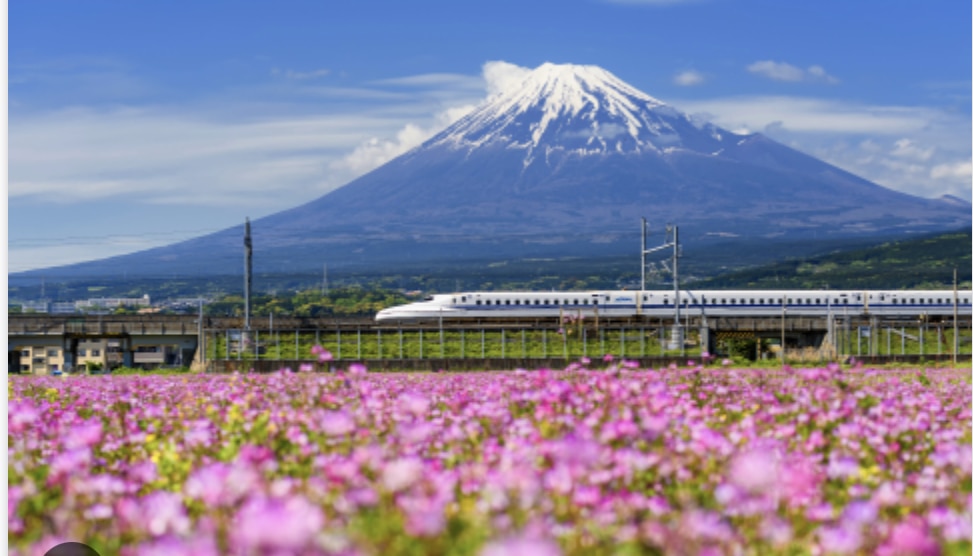
The closest airport to Kyoto is Osaka (Kansai), but it is difficult to get a direct flight to Osaka from US/Europe. If instead you have chosen to travel via Tokyo then you will be flying either to Haneda or Narita. Haneda is very close to central Tokyo; Narita is about 45 minutes north-east, and you will need to travel through Tokyo to get to Kyoto.
The main train station hub connecting the airports to Tokyo and Kyoto is Shinagawa.
Get to Tokyo from Haneda Airport
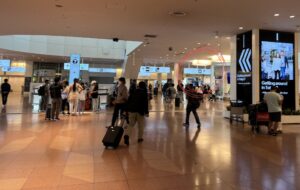 Once you’ve picked up your luggage and gone through customs and are in the main arrivals area look out for the overhead sign to the Keikyu-Kuko (“KK”) line (it is light blue). Depending exactly on where you are it should be ahead and to the right. If you have bought an IC/Suica card you can pay with that, or there is a ticket office at the entrance. Once you’ve gone through the ticket barrier take the 2nd right (the first right takes you to the platform to go to other terminals) and take one of the 3 elevators down to the platform. It is clearly marked for Shinagawa.
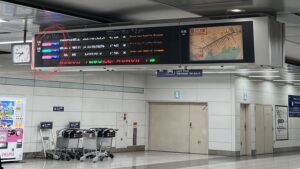 Once on the platform take the next train that stops at Shinagawa – the neon pink and green area on these overhead information boards on the platform alternates English and Japanese - it will either say “for Shinagawa” or for somewhere else. Take any one that says “for Shinagawa”. I can’t tell you exactly how many stops, as this depends on which train you get, but all stops are numbered – the airport is stop 16 and Shinagawa is stop 1.
If you are staying in Tokyo then Shinagawa is your gateway to wherever you are going. Try Google Maps, or my kids swear by this app. 
Get to Tokyo From Narita Airport
The easiest way to Tokyo from Narita is the Narita Express to Shinagawa. There is only 1 train per hour so depending on the time  of the train there may be faster ways, but this will mean changing trains, and using trains with less space for luggage. Follow signs for the Narita Express (NEx). This is the logo – it is often in red. Sometimes there is a route marked on the floor!! Buy a ticket at the ticket booth – this will also get you a reserved seat.
If you are staying in Tokyo you have the option to get off the NEx at Tokyo Station, 1 stop before Shinagawa, if this is closer to where you are going.
Get to Kyoto or Hamamatsu from Tokyo
From either Shinagawa or Tokyo Station you need to get the Shinkansen (bullet train). 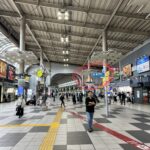 Follow the signs to the Shinkansen for the tracks and the ticket office. I took this photo at Shinagawa early on a Sunday morning - usually it will be packed!!
At Shinagawa there are 2 entrances to the Shinkansen – North and 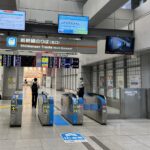 South. Both have ticket offices. The North has better shops if you want to pick up food to eat on the train.
There are machines that you can buy your ticket from, but although they have an English option it is still a very complicated process, so I suggest you use the ticket office - they will speak enough English. As well as your destination they will ask you if you want reserved or non-reserved seating. This is just as it sounds – a reserved seat costs about ¥1,300 more than non-reserved. Non-reserved is a cultural experience you should try, but not perhaps for your first journey and with luggage!
How to Use the Bullet Train
If you are travelling with luggage that is too heavy to lift onto the overhead rack you will need to reserve a seat with luggage space. This will get you the end seat in the carriage, and there is luggage space behind your seat. YOU CANNOT USE THIS SPACE IF YOU HAVEN”T RESERVED IT. This doesn’t cost extra, but as there are fewer seats available it may mean that you need to take a later train. Alternatively, if you are staying in Tokyo a while, book the ticket at the Shinkansen travel office when you arrive.
If the train is not too busy you can ask to be seated on Fuji-san side (on the right travelling from Tokyo) so you can see Mt Fuji if it is a clear day. There will be several trains an hour.
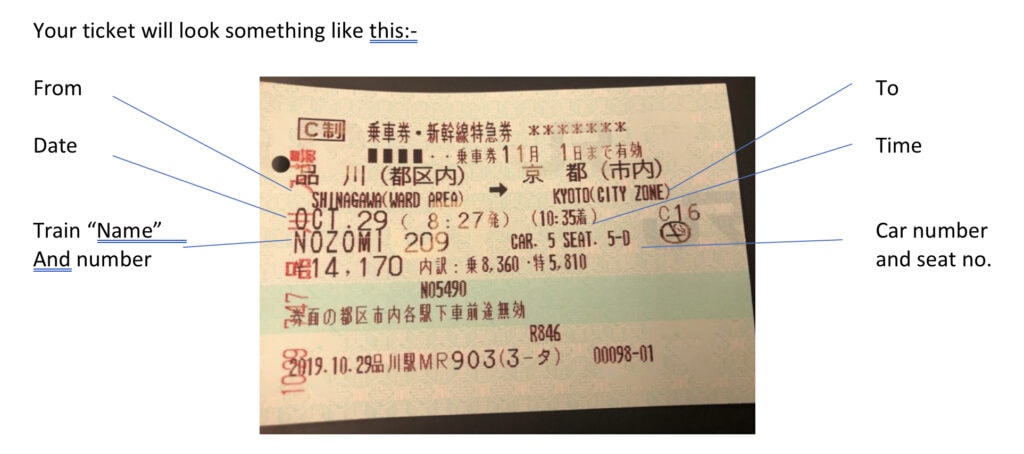
Each train has a name and number (on this example NOZOMI 209). (The NOZOMI and MIZUHO are the fastest – you cannot use the Japan Rail Pass on these trains, and they do not stop at Hamamatsu). Find the name and number on the overhead information boards to find your platform (see the ticket barrier photo above).
BE AWARE THAT AS MANY AS 6 OR EVEN 8 TRAINS MAY USE THE SAME PLATFORM IN THE SPACE OF AN HOUR. YOUR TRAIN WILL ARRIVE ABOUT 1 – 2 MINUTES BEFORE THE SCHEDULED TIME AND WILL LEAVE EXACTLY ON TIME – DO NOT GET ON AN EARLIER TRAIN AS YOU MAY FIND YOURSELF IN THE WRONG DESTINATION
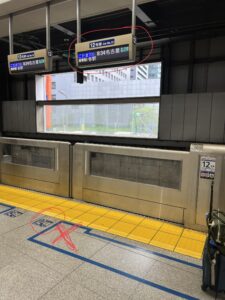 When you get to the platform it is likely that other trains will be scheduled to use the platform before your train. The information board shows the trains in order, with the next train at the top. When the board shows that your train is next, line up on the platform. When the train arrives, the door for each carriage will be in the exact place marked on the platform, so if you have a reserved seat check your ticket for the number of the carriage your seat is in and find that area of the platform. On my photo, you would stand on the red X (or line up behind if there are already people standing here) if you are in carriage 12.
When the train arrives the doors will open automatically. Board the train as quickly as you can. There is a luggage shelf the length of each carriage for smaller cases and bags. Larger cases can be left behind the first row of seats if you reserved luggage space when you bought your ticket.
A display inside the carriage will show the name of the next station alternating between Japanese and English when you get close. There will also be an announcement in English. Grab your luggage and head for the door before the train stops, as they stop only very briefly. You will need your ticket to exit through the ticket barrier.
You made it!!